Bride of the Wind

Visionary surrealist Leonora Carrington is channeled in a major new exhibition at the Musée du Luxembourg

Above Image: Artes 110 (1944), oil on canvas. © 2026 Estate of Leonora Carrington / ADAGP, Paris.

By Aliette Boshier

For the artist and writer Leonora Carrington (1917–2011), creativity was an innate, transformative force through which she distilled the totality of her experience into a singular iconography rooted in symbolism and myth. A fearless explorer of material and metaphysical realms, she conjured a disquieting parade of shape-shifting beings, zoomorphic furniture, and pale, inscrutable sylphs that beckon the viewer ever onward into the depths of the unconscious.
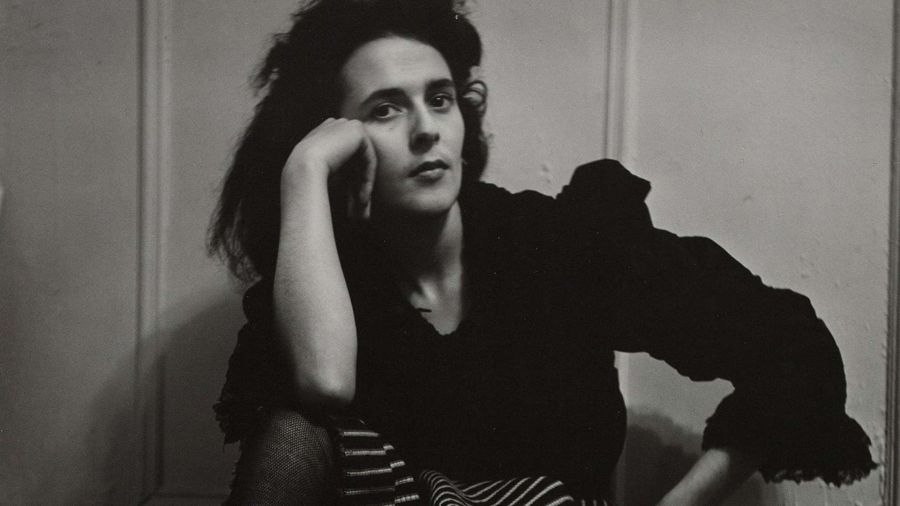
The artist Leonora Carrington.

A major new exhibition at the Musée du Luxembourg in Paris traces the contours of Carrington’s extraordinary life through the evolving themes of her work, from an early creative awakening steeped in Celtic fairy tales and Italian narrative painting to a sophisticated visual language developed in her adopted home of Mexico, where esoteric wisdom, feminine agency, and alchemical inquiry converged.

It marks something of a retour aux sources for the artist, the first monographic show in the city that nurtured her youthful rebellion against English high society and her induction into surrealist circles. It was also in France, amid the soaring limestone cliffs of the Ardèche region, that she and her lover Max Ernst refashioned a tumbledown farmhouse into a site of shared artistic experimentation—before war and psychological rupture set her on a different course.

Ernst christened Carrington the Bride of the Wind, and while she firmly resisted the arbitrary identities imposed upon her by men, this epithet nonetheless captures the quixotic, unknowable qualities of both her spirit and her oeuvre. A lifelong affinity with the natural world moved her to populate her works with what she referred to as her “inner bestiary” of blue-eyed hyenas, long-necked birds, and winged serpents. The uncanny presence of hybrid figures in paintings like And Then We Saw the Daughter of the Minotaur (1953) imparts an air of initiation, suggesting identity as something both mutable and empowering. Out of this pantheon of creatures, the horse emerges in various guises as her most recurrent animal totem—from the immobile toy of the childhood nursery to an expression of untamed psychic freedom and emancipation from patriarchal authority.

Sœurs de la lune, Diana / Sisters of the Moon, Lucienne; La Sorciere / The Sorceress; and Diana (1932). Watercolor, pencil, and ink on paper. © 2026 Estate of Leonora Carrington / ADAGP, Paris.

Her friend and patron, the poet Edward James, affirmed that Carrington was “endowed from birth with the versatility of a Renaissance man … a sort of Philip Sidney.” The ideal of the humanist polymath flourished in her, and although best known for painting and writing, she was endlessly experimental in her practice, harnessing drawing, sculpture, textiles and tapestry, jewelry, printmaking, and theater design to give shape to her interior landscape.

Carrington approached her craft with the meticulous care of a master, rendering oneiric scenes like The House Opposite (1945) and Orplied (1955) in fine brushstrokes of egg tempera or oil in shades of cinnabar, burnt umber, and mineral blue. “The real work is done when you’re alone in your studio and that’s it,” she famously stated.  

“The real work is done when you’re alone in your studio and that’s it.”

For her that work was a means of giving form to the ineffable: a ritual vessel for the hypnagogic visions and resurfaced memories that bubbled and brewed upon the canvas. As exhibition co-curator Tere Arcq notes, Carrington’s art enacts a kind of embodied understanding—she does not simply show us what she knows but inhabits it in the process of creation. Hers was a “map of the soul drawn not in theory but through the lived experience of revelation.”

Although she spent periods of time in North America, and often felt the pull of nostalgia for the England of her youth, it was in Mexico that Carrington found a lasting sense of belonging. There, in a land where syncretic rites and Indigenous mythologies are threaded through everyday life, the veil between the physical and the spiritual became ever more thin.

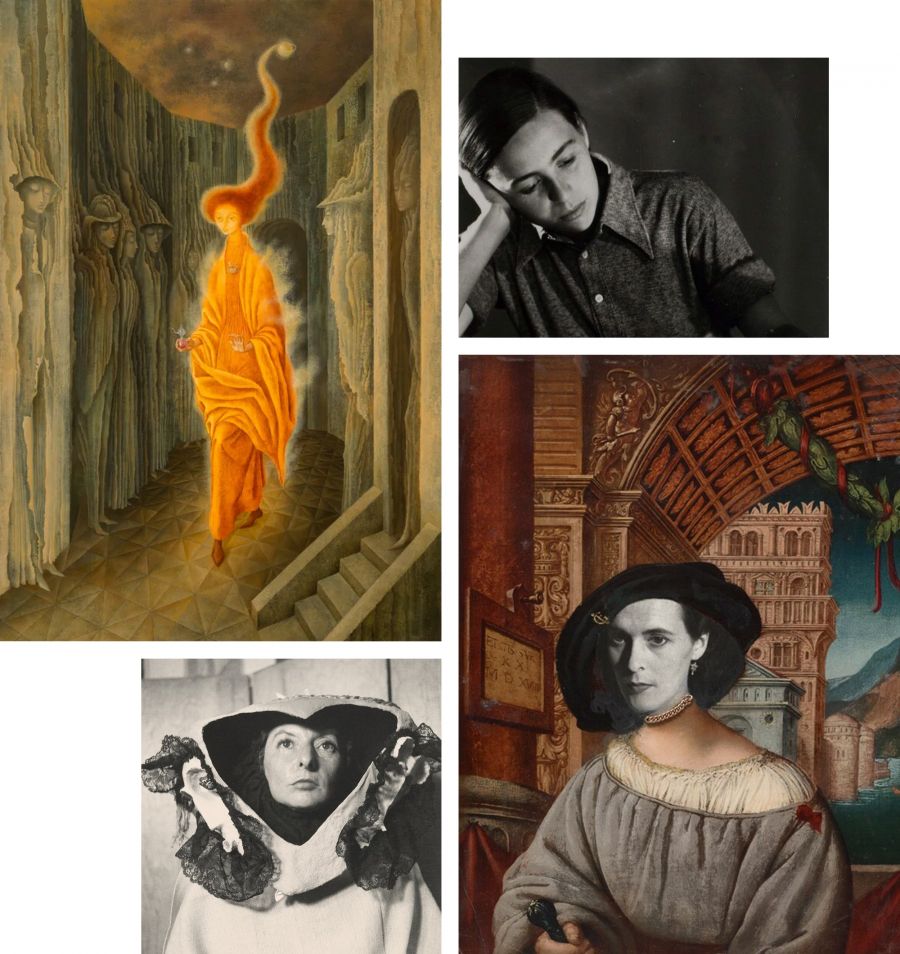
From her arrival in 1942, her work was increasingly shaped by the unexpected joys of motherhood and the domestic sphere. Underpinned by intellectual kinship and a strong social conscience, she also forged enduring bonds of sorority with fellow exiled European artists such as Remedios Varo and Kati Horna. The trio would come to be referred to as the “three witches of surrealism.”

Clockwise from top left: La llamada /The Call (1961) by Remedios Varo. Kati Horna in the studio of József Pécsi, (1932), detail. Photo by Robert Capa. Portrait of Leonora Carrington (1957) by Kati Horna. Varo in a mask by Leonora Carrington. Photo by Kati Horna. 

Carrington was legendary for sidestepping any attempt to explain her work. Toward the end of her life, in conversation with the writer Chloe Aridjis, she flashed that defiant streak: “You’re trying, desperately, to intellectualize me. And you’re wasting your time.” Although she did not court notoriety, this oracular quality and resolute self-possession have led to growing critical engagement with the artist in recent years, from an expanding body of scholarship and creative interpretation to international exhibitions like the 2022 Venice Biennale, The Milk of Dreams, the curatorial theme of which was inspired by Carrington’s children’s book of the same name.

For all her flights of imagination, Leonora Carrington was attuned to the “dailiness” of being, where the ordinary and the numinous coexist and meaning is left for the individual to divine. As she observed, “There are things that are not sayable. That’s why we have art.”

Two Henry Adams Street, Suite 2M-33
San Francisco, CA 94103

© 2022 SAN FRANCISCO DESIGN CENTER  |  TERMS + CONDITIONS  |  PRIVACY POLICY