A Dash of Daring

Christopher Farr Cloth’s new collection with German artist Olaf Hajek is imbued with a lively, optimistic spirt. Maile Pingel talks with Hajek about the story behind its creation.

Above Image: Artist and illustrator Olaf Hajek in his studio in Mallorca. Photo by Anthony Perez courtesy of Christopher Farr Cloth.

By Maile Pingel

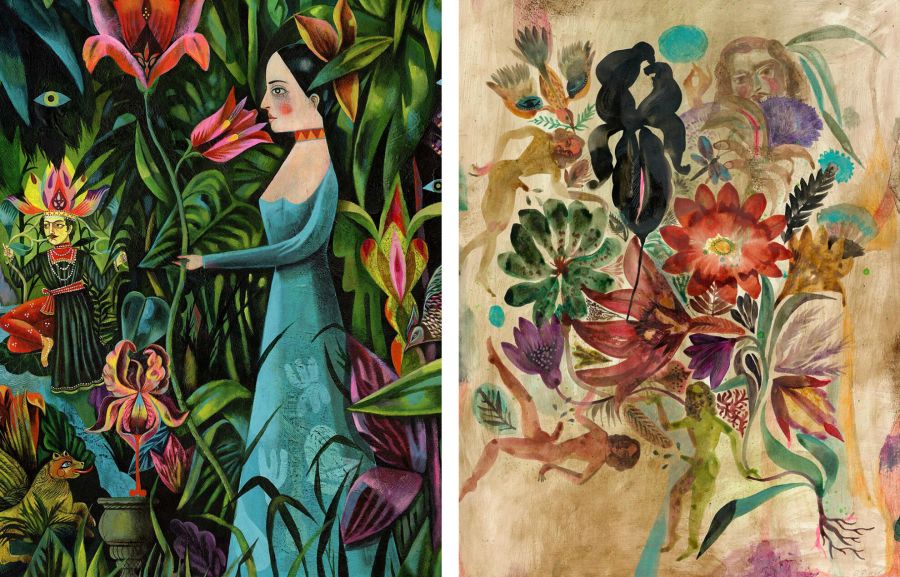
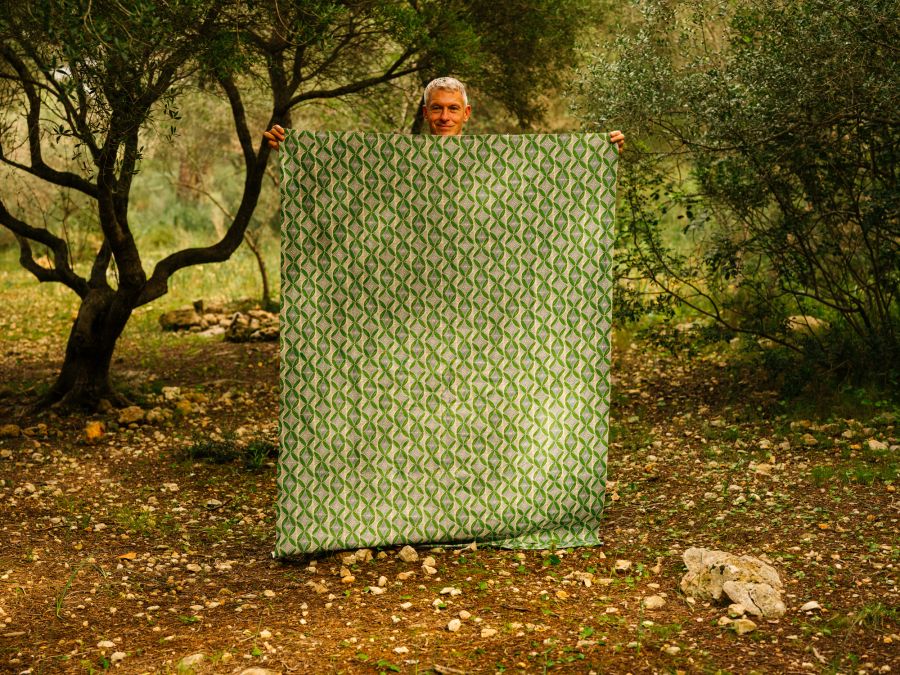
Olaf Hajek’s designs for Christopher Farr Cloth are an exploration of color and movement, their patterns honoring nature and human celebration in an almost radically joyful way. The collection, the first of this kind for the artist, includes two printed linens and four wallpapers. “It allowed me to think not only about a single artwork, but about how patterns, colors, and narratives can become part of everyday life,” he says from his studio in Palma de Majorca. “I’ve always been interested in creating immersive worlds and this collection has the ability to completely transform a space emotionally and atmospherically.”


How did this collaboration begin?

Michal Silver (Christopher Farr Cloth Creative Director and Co-Founder) saw my work and felt there could be an interesting dialogue between my visual world and the language of textiles and interiors. She asked if I could imagine creating a collection for them, and it immediately felt like an inspiring encounter. What fascinated me most was the artistic freedom they offered; there was a great sense of trust, which allowed me to approach the collection almost as I would approach a series of paintings. I started intuitively sketching and developing motifs, and many of those early concepts resonated with the team.
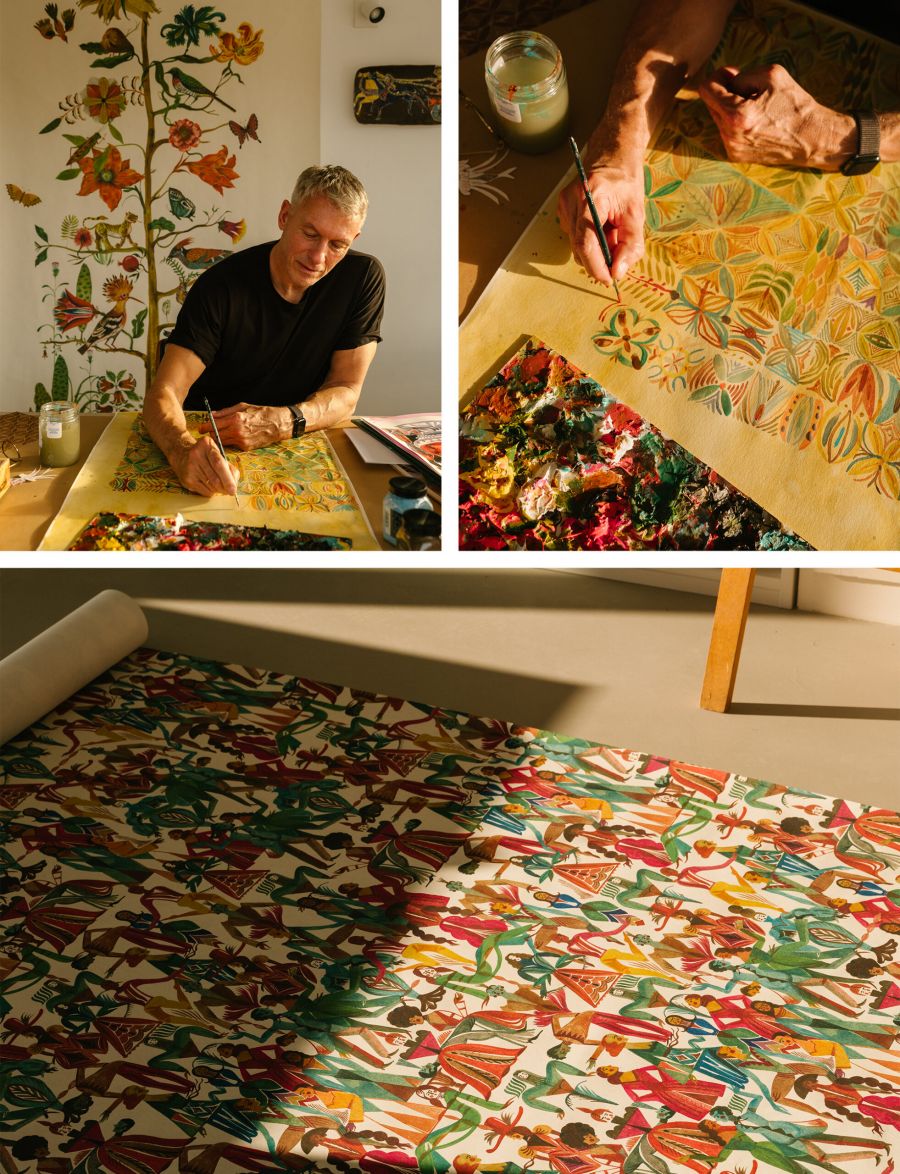
Hajek at work on the original art for the collection. Dancing Parade wallpaper. Photos by Anthony Perez courtesy of Christopher Farr Cloth.

Did designing for production differ from your fine art practice?

It felt like a natural extension rather than a completely different discipline. From the beginning of my career, I never wanted to place strict borders between art and applied work. In fact, the freedom I experience in my painting practice often becomes the source of energy for my design work as well.

“I never wanted to place strict borders between art and applied work. In fact, the freedom I experience in my painting practice often becomes the source of energy for my design work as well.”

Cloclwise from upper left: The Dandy’s Garden, Hajek’s solo exhibition at Esther Schipper Gallery in Paris. The River of Joy and Trees of Wonder wallpapers for Christopher Farr Cloth.

How do Germany, your homeland, and Mallorca, your adopted home, inform your work?

Berlin and Palma influence my work in equally important ways. Berlin is a city of stimulation and speed, but winters make me melancholic; Palma gives me the endless light of the Mediterranean, and my studio is next to the Fundació Juan Miró, his former atelier, which is meaningful to me. My work exists somewhere between these two poles, between intensity and calmness, structure and freedom, urban life and nature.

Tell us about your creative process.

Travel plays an important role, as does everyday life and observing details others might overlook. I’m deeply inspired by folk art—miniature paintings from India, African sculptures—and by art history, modern art, design, ceramics, and textiles. They become an archive in my mind that I continuously revisit and transform into a new and more universal visual language. I take photographs and make quick sketches too, but often impressions stay in my memory and evolve there. My studio process is then about reconnecting these collected fragments and allowing unexpected combinations to emerge naturally.

How have you found visits to California?

There’s an open and creative energy there, with certain connections to Mallorca, especially in terms of light, landscape, and the relationship between nature and lifestyle, but what fascinated me is its cinematic contrasts: the vastness of Joshua Tree, the urban energy of Los Angeles, and the Pacific coastline of San Francisco.

Whimsy is a theme in this collection. Why was that important?

A sense of wonder becomes increasingly important in a world dominated by uncertainty and tension, so I wanted to create moments of escape that invite people into something lighter, more playful. Pattern names like Dancing Parade and River of Joy reflect this idea directly. They suggest movement, celebration, rhythm, and connection, moments where people, nature, and ornament merge. They’re not about superficial happiness, but about the human need for warmth, imagination, and emotional connection.

Olaf Hajek’s collection for Christopher Farr Cloth is available through De Sousa Hughes.

Two Henry Adams Street, Suite 2M-33
San Francisco, CA 94103

© 2022 SAN FRANCISCO DESIGN CENTER  |  TERMS + CONDITIONS  |  PRIVACY POLICY